
Deaf Smith County Release Meaning
A release from Deaf Smith County Jail means one jail episode ended. The person may have returned to the community on bond, after dismissal, by court order, after time served, or at sentence completion. Yet departure can also mean transfer to TDCJ, another county, the U.S. Marshals Service, or ICE. A transfer ends custody at one building without ending confinement.
The Deaf Smith County Sheriff operates the local jail. The official sheriff page has no public roster, historic booking search, or release list. Once a person leaves any live custody view, the durable sources are the jail admission and release record, the criminal docket, and the receiving agency’s record. Ask for the exact release code and its definition. “Not found” alone does not state why the person disappeared.
| Release path | Meaning | Next check |
|---|---|---|
| Bond | Physical release while the case continues | Court and jail record |
| Time served or completion | Custody ends under the sentence | Judgment and release record |
| Probation | Court supervision in the community | CSCD and court order |
| TDCJ parole or mandatory supervision | Conditional state-prison release | TDCJ Parole Division |
| Transfer or detainer | Another custodian takes control | Receiving agency |
Deaf Smith Release Record Fields
Deaf Smith County does not publish an online release-record schema. A narrow request should ask only for fields the jail maintains and let the custodian identify withheld or nonexistent items. Tie each request to one admission with a booked name, booking number, date of birth, or bounded booking date. This prevents two jail stays from being merged.
| Field | What it can show |
|---|---|
| Booking number and time | The admission linked to the later departure |
| Release date and time | The jail’s recorded physical checkout |
| Release reason or code | Bond, order, time served, transfer, or other coded basis |
| Destination or receiving agency | Community departure versus continued custody |
| Charge and court | The case file needed for legal disposition |
| Bond and hold data | Conditions or another agency’s claim |
| Property acknowledgment | Any maintained record of property return |
A release record does not prove that every charge ended. It also does not prove arrival at a receiving facility. Match a transfer destination to that agency and match a dismissal, sentence, or bond to the court docket.
Request Deaf Smith Release Records
Texas Government Code Chapter 552 governs a written request to the Deaf Smith County Sheriff. The sheriff page does not publish a records form, records email, local fee, or fixed production time. Begin at the official sheriff page or call 806-364-2311 for the current public-information officer and accepted delivery method.
- Identify the person and one bounded jail episode with a booking number or date range.
- Ask for the existing admission and release record, release date and time, reason and code definition, destination, charge, court, and hold notation.
- Request electronic public portions and ask the office to cite any exception used to withhold a part.
- Ask for a cost estimate before costly work. Fees depend on medium, volume, labor, and state rules.
- Preserve the response, field definitions, generated date, and any statement that no record exists.
Deaf Smith County Sheriff
Sheriff: J. Dale Butler
Phone: 806-364-2311
Call for the current records address, email, hours, and request method.
The Act requires prompt handling under its rules, but no fixed completion day should be promised. Ask separately about retention for the exact jail record series.
Deaf Smith Release Record Limits
Public access can change through law or court order. Juvenile rules, active law-enforcement concerns, security information, privacy, expunction, and nondisclosure may affect what the sheriff or clerk releases. Texas Code of Criminal Procedure Chapter 55A now governs expunction. Government Code Chapter 411 governs nondisclosure. Neither result should be assumed from a person’s release type.
An expunction order can restrict release and use of records as directed by the order. Nondisclosure limits public access but is not the same as destruction and allows access by specified agencies. Deferred adjudication is not automatically confidential. If a record once appeared and later vanishes, ask the custodian whether a lawful order or exception applies without seeking protected details.
Texas public-information rules do not make every item in a sheriff file public in the same way. Basic arrest facts, a release report, a booking image, and investigative material may receive different treatment. The Sheriff may apply a statutory exception to part of a responsive file while releasing other separable portions. A requester should therefore ask for public portions and the legal basis for any withheld part instead of treating one redaction as denial of the whole release event.
State-prison records follow a related but distinct route. Government Code section 552.029 identifies specified TDCJ information that is not withheld under the general inmate-information provision, including core identity, sentence, unit, department photograph, parole, and earliest or latest possible release fields. Other law can still control. Deaf Smith County cannot certify a TDCJ discharge, and TDCJ cannot certify the county jail’s checkout time.
- Time served
- Custody credit satisfies the term stated by the court.
- Detainer
- Another authority asks the custodian to hold or transfer the person.
- Discharge
- The formal end of a sentence or supervision term.
- Expunction
- A court-ordered Texas process controlling covered records.
Find Deaf Smith Released Inmates
Start with the custody system that last held the person. The sheriff offers no public recent-release feed, so a named local search begins with the jail phone, current IVSS-Counties status, and the court. A TDCJ search applies only if the person entered state prison. Federal and immigration tools should be used only when those forms of custody are independently indicated.
- Confirm the full booked name, date of birth, booking or case number, and approximate dates.
- For a local jail episode, call the sheriff and request the individual release record or a bounded daily log.
- Check the district or county court for bond, dismissal, sentence, probation, commitment, or revocation entries.
- For TDCJ custody, use the current inmate search, state IVSS, and TDCJ information channels.
- For federal or immigration custody, use BOP, the federal docket, USMS, or ICE as appropriate.
- Match release reason and destination to the receiving agency before calling a transfer a community release.
Important: Released people usually leave a live roster, so an absent name is a cue to seek the release record, not proof of release.
Deaf Smith TDCJ Search Limits
The TDCJ Online Inmate Search shows only people currently incarcerated in TDCJ and warns that its data is at least one working day old. Search by last name plus at least a first initial, TDCJ number, or SID number. Optional name, gender, and race fields can narrow a match. A detail may show the TDCJ number, unit, offenses, sentence facts, projected release date, parole eligibility date, and maximum sentence date.
The official search screen below makes the current-custody and data-age limits visible.
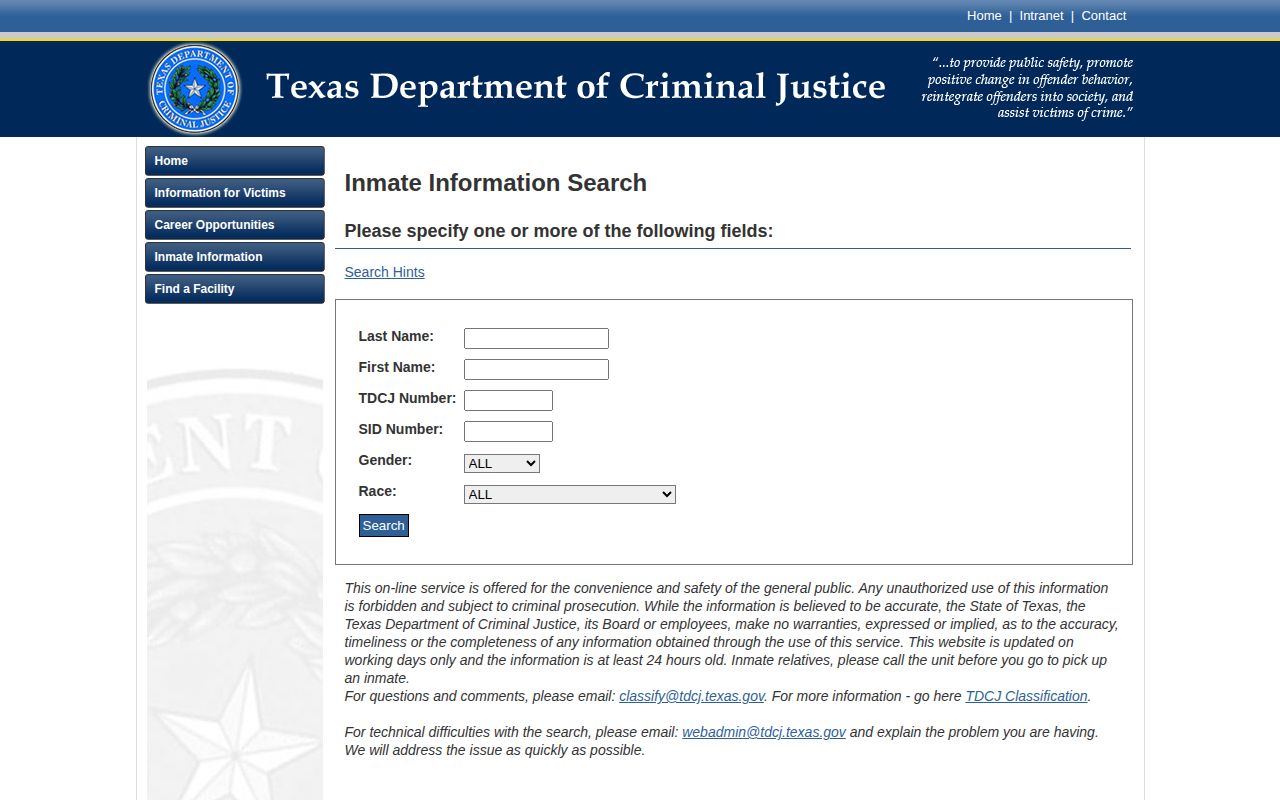
After actual release, use Texas state IVSS, parole information, or a TDCJ public-information request for public release and discharge fields. A projected date is not an actual release, and parole eligibility is not a promise of release.
Deaf Smith Release System Comparison
Each official source covers a different legal custodian. Searching every portal without first identifying custody can create false matches and false conclusions.
| System | Best use | Main limit |
|---|---|---|
| Deaf Smith Sheriff record | Local booking and physical departure | No public online roster or feed |
| District or County Clerk | Bond, judgment, dismissal, probation, revocation | Case action is not a checkout time |
| IVSS-Counties | Participating county status and alerts | No-result does not confirm release |
| TDCJ search and state IVSS | State prison, parole, mandatory supervision | Ordinary search is current prisoners only |
| BOP locator | Federal prison release status | Does not rule out another hold |
| ICE ODLS | Current and limited recent ICE custody | Missing results have several causes |
For parole, Deaf Smith maps to the Amarillo DPO. Ordinary probation is handled by the local CSCD and court. The Deaf Smith parole and probation record route separates those two offices.
Deaf Smith Release Notifications
Texas replaced county VINE with IVSS-Counties on September 1, 2025. The Deaf Smith sheriff page still uses the VINELink name, but the current portal is https://ivss-counties.tdcj.texas.gov/ and support is 866-268-8959. Search by full or partial name, DOC ID, SID, Jail ID, or Permanent Booking Number. Register from the matching record for offered call, text, or email preferences.
IVSS updates status around the clock but disclaims completeness and timeliness. It also warns that people no longer in custody may not appear. Current registration uses portal controls and account or contact preferences. The old four-digit VINE PIN is historical troubleshooting, not a current enrollment instruction. State-prison notices use the separate TDCJ IVSS system.
Match an IVSS result by more than a similar name. Compare the source agency and every available ID, save the exact status, and record the check time. An Unknown or Undisclosed location may relate to a pending matter and must not be rewritten as release. If Deaf Smith County Jail does not appear as a source, call support and the sheriff to check participation and obtain the official record route.
A registration can remain active after the person disappears and may give notice if that person returns to custody. Existing VINE registrations carried over in the transition, though a password update and new provider may affect access. A notification is not an official release record or a safety guarantee. Confirm the event with the custodian and preserve the exact alert wording and time.
Deaf Smith Court Record Path
The Deaf Smith District Clerk is the district and felony custodian. Ask by defendant name and case number for the docket, judgment, sentence, jail credit, bond or release order, dismissal, probation terms, revocation, commitment, and final disposition. The public county page does not provide a tested criminal-search link even though the office uses iDocket.
The official District Clerk source is shown below and provides the local contact route.
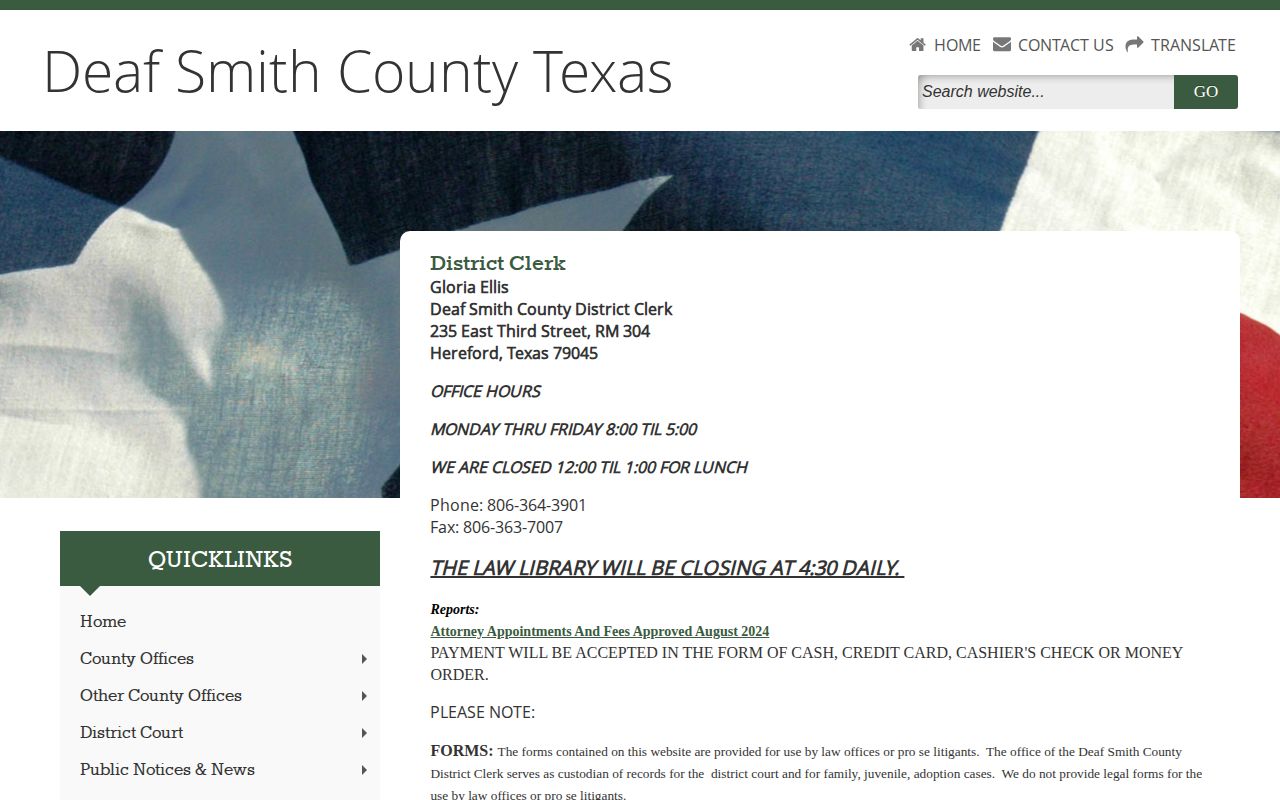
The County Clerk should be called for misdemeanor access. Its listed online vendors concern land and deed records, not a proven criminal docket. A court dismissal can explain legal authority for release, but another hold may still continue custody.
Getting Home After Deaf Smith Release
TxDOT identifies Panhandle Community Services and Panhandle Transit District as the rural transit provider covering Deaf Smith County. The listed phone is 806-342-6105, with an Amarillo office. This establishes a demand-responsive regional option, not a jail-door shuttle, free ride, fixed stop, or immediate pickup.
Arrange availability and pickup location in advance. Separately call the jail to ask where a permitted ride may wait at the Progressive Road complex. Official sources do not publish a family waiting zone, taxi rule, rideshare rule, or after-hours discharge schedule. Those gaps should remain clear rather than being filled with assumptions.
Deaf Smith Bond Time Rules
Deaf Smith’s indigent-defense plan gives “24-hour” and “72-hour” a legal meaning that is separate from a release list. Under its Article 17.033 procedure for certain warrantless arrests without a timely probable-cause finding, the cited safeguards use 24 hours for a misdemeanor and 48 hours for a felony, with a state-requested postponement that may extend no longer than 72 hours in the applicable setting.
Those figures do not create online 24-hour or 72-hour feeds. They also do not guarantee release for every arrest within that span. Bail, other cases, warrants, and holds can change the result. The local jail publishes no rolling recent-release window, so request a date-bounded report for the desired period.
Who Controls Deaf Smith Release
A 2024 contract allowed some Potter County prisoners to be housed in Deaf Smith while Potter remained responsible for transport and ordinarily for bond-out. The agreement is historical unless renewed. It does prove a key local point: the building where a person sleeps and the agency that owns the hold can differ.
Ask the jail which authority controls the person’s release. Then verify with that county, court, or receiving agency. Physical departure from Hereford could mean transport rather than community release. Preserve both the Deaf Smith checkout and the next agency’s admission when the destination field identifies a transfer.
Deaf Smith Jail Release Context
The current Deaf Smith County Jail and Sheriff complex opened in 2022 after a 2020 through 2022 construction project at 3780 and 3782 N. Progressive Road. The Texas Commission on Jail Standards reported a 196-bed facility. Capacity is not an annual release total, current population, or proof of timing, so it should never be presented as the number of people released.
Construction records mention a secure vehicle sallyport, but that is not evidence of a public pickup point. No official release-hours, property-return, gate-money, or weekend checkout policy was found. Call 806-364-2311 before travel and ask for the current public entrance, allowed waiting place, property requirements, and whether another custodian is scheduled to transport the person.
Deaf Smith Federal Release Search
The BOP locator covers federal inmates from 1982 forward and can show a RELEASED status, release date, and location. RELEASED means no longer in BOP custody. It does not rule out supervised release, immigration custody, or a state or local hold. Federal defendants held by USMS may be housed in a local jail, while the federal docket and holding agency remain the key sources.
ICE ODLS accepts a nine-digit A-number or exact name with birth date and country of origin. It can cover current detainees and some people released within the prior 60 days, subject to exclusions and lag. No result does not disprove ICE custody or an earlier release. Use the release papers, ERO, and immigration-court status for separate questions.
Deaf Smith County Jail Facility
Deaf Smith County has one verified public-facing detention facility. The Deaf Smith County Jail release page covers its official contact and local confirmation route. No TDCJ prison, federal prison, or ICE detention center was identified inside the county. Police stations and courthouses were not added as fake facilities.
- Deaf Smith County Jail: county jail operated by the Sheriff; releases may go to the community, local supervision, TDCJ, another county, federal custody, or immigration custody.
Confirm community release with the jail record and criminal docket. Confirm transfer with the receiving agency.
Public Record Search
Sponsored Results