
Deaf Smith Release Date Labels
A projected date is an estimate, not proof that a person walked out of custody. For a Texas prison term, TDCJ Classification and Records computes the projection under the judgment, applicable law, credits, classification, and Board action. A Deaf Smith County Jail departure follows a different chain. Jail staff apply the controlling court order, bond authority, jail credit, sentence terms, and any active holds. A TDCJ formula should never be applied to a person who has not entered state custody.
A pretrial detainee usually has no fixed inmate release date. Release may depend on posting bond, a personal bond, dismissal, acquittal, a court order, or resolution of another hold. Even when a judge signs an order, the jail must complete processing and check for other custodians. The court order establishes legal authority; the jail's admission and release record establishes the physical checkout time.
Search Deaf Smith Release Dates
Begin with the custodian, not a guessed sentence calculation. The TDCJ Online Inmate Search includes only people currently incarcerated in TDCJ. Its data is updated on working days and is at least 24 hours old. It cannot confirm a release from Deaf Smith County Jail or serve as an archive of fully discharged Texans.
- Identify the custody system. Call the Deaf Smith County Sheriff at 806-364-2311 for a county booking. Ask whether the person remains held and whether another agency owns a hold.
- Search TDCJ when state custody is indicated. Use last name plus at least a first initial, a seven-digit TDCJ number, or a SID number. Optional first name, gender, and race can refine results.
- Copy each date label exactly. Record the Projected Release Date, Parole Eligibility Date, Maximum Sentence Date, and any Scheduled Release Date and Location.
- Check the court authority. The District Clerk holds felony and district case records. A judgment, amended order, or jail-credit entry can explain a change.
- Confirm the event. Use the jail release entry for a county departure or TDCJ release certificate and status staff for a state discharge.
The broader Deaf Smith County released inmate search helps trace a person after the live custody display no longer shows them. If a person moved to another county, federal custody, or immigration custody, that receiving agency becomes the correct source.
Texas Good Time Calculations
Texas Government Code Chapter 498 says good conduct time affects eligibility for parole or mandatory supervision. It does not reduce the sentence imposed. Eligible TDCJ classifications may earn different rates, and discipline may forfeit credit. Trusty or Class I status may earn 20 days per 30 actual days, with possible added trusty credit; Class II may earn 10; Class III earns none. Those figures are inputs under state rules, not a do-it-yourself release formula.
Texas has no general rule that every prisoner must serve 85 percent. For specified Article 42A.054 offenses and deadly-weapon findings, Government Code Chapter 508 generally bases parole eligibility on one-half of the sentence or 30 calendar years, whichever is less, with at least two calendar years and no good-time credit in that calculation. Mandatory-supervision exclusions and discretionary review also matter. Offense date and sentence type control which version of law applies.
State-jail felonies require special care. They generally are not parole cases. A court may award diligent-participation credit in a qualifying case, after which TDCJ recalculates from the proper order. The sound sources are the judgment and TDCJ computation, not arithmetic based only on sentence length.
Why Deaf Smith Dates Change
One date can move more than once because TDCJ must apply the whole record. The date shown should be saved with the date checked and described as subject to change. An older screenshot may remain useful evidence of what the system displayed, but it is not a current promise.
| Factor | Possible effect | Best confirmation |
|---|---|---|
| Amended judgment or jail credit | Changes the sentence computation | Court order and TDCJ audit |
| Discipline or classification | Forfeits or alters good conduct time | TDCJ classification record |
| Board approval or denial | Moves parole or mandatory-supervision path | Board status and decision code |
| Program or placement need | Delays operational scheduling | TDCJ release status staff |
| New case or detainer | May continue custody elsewhere | Owning agency and court docket |
| Concurrent or consecutive terms | Changes the controlling endpoint | Judgments and sentence calculation |
A parole approval does not by itself release a person. Certificate review, conditions, placement, and discharge processing remain. A detainer is another agency's request to hold or receive someone. When that agency takes custody, departure from TDCJ or the county jail is a transfer, not necessarily a return to the community.
Four TDCJ Release Fields
TDCJ date labels answer different questions. Projected Release Date is Classification and Records' estimate if parole does not occur sooner. Parole Eligibility Date is the point at which review may occur, not a guaranteed exit. Maximum Sentence Date is the full-term endpoint after lawful computation. Scheduled Release Date and Scheduled Release Location appear only after operational planning advances.
- Projected Release Date
- A movable calculation based on the record and applicable eligibility rules.
- Parole Eligibility Date
- A review threshold. The Board may approve or deny release.
- Maximum Sentence Date
- The computed full-term endpoint, subject to corrections and lawful credits.
- Scheduled Release Date
- An operational date that may still change before discharge.
The official TDCJ definitions show how projected release changes with mandatory-supervision eligibility. That state explanation is illustrated below. It helps decode the field, but the named person's current detail and underlying judgment remain essential.
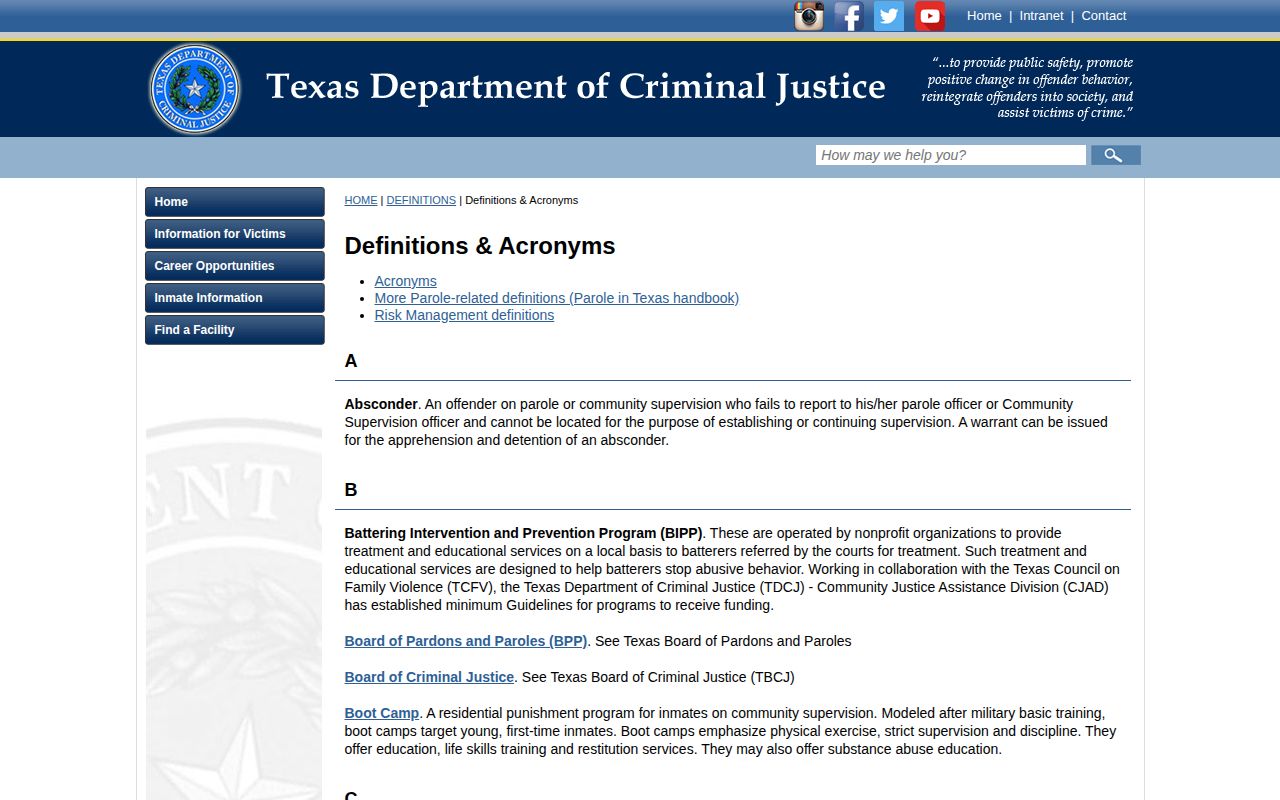
The definition makes the conditional nature of a projection visible. It should be read beside the person's current TDCJ status, not as a fixed calendar promise.
Deaf Smith TDCJ Search Limits
The standard TDCJ locator stops being useful as a live lookup after full discharge because it is limited to currently incarcerated prisoners. A blank result can mean the person was never admitted, has not yet been processed, or has left TDCJ. It does not establish which explanation is correct.
The official search screen documents both the available fields and the current-incarceration limit. Its capture below is useful when deciding whether to switch from a live locator to a historical record request.
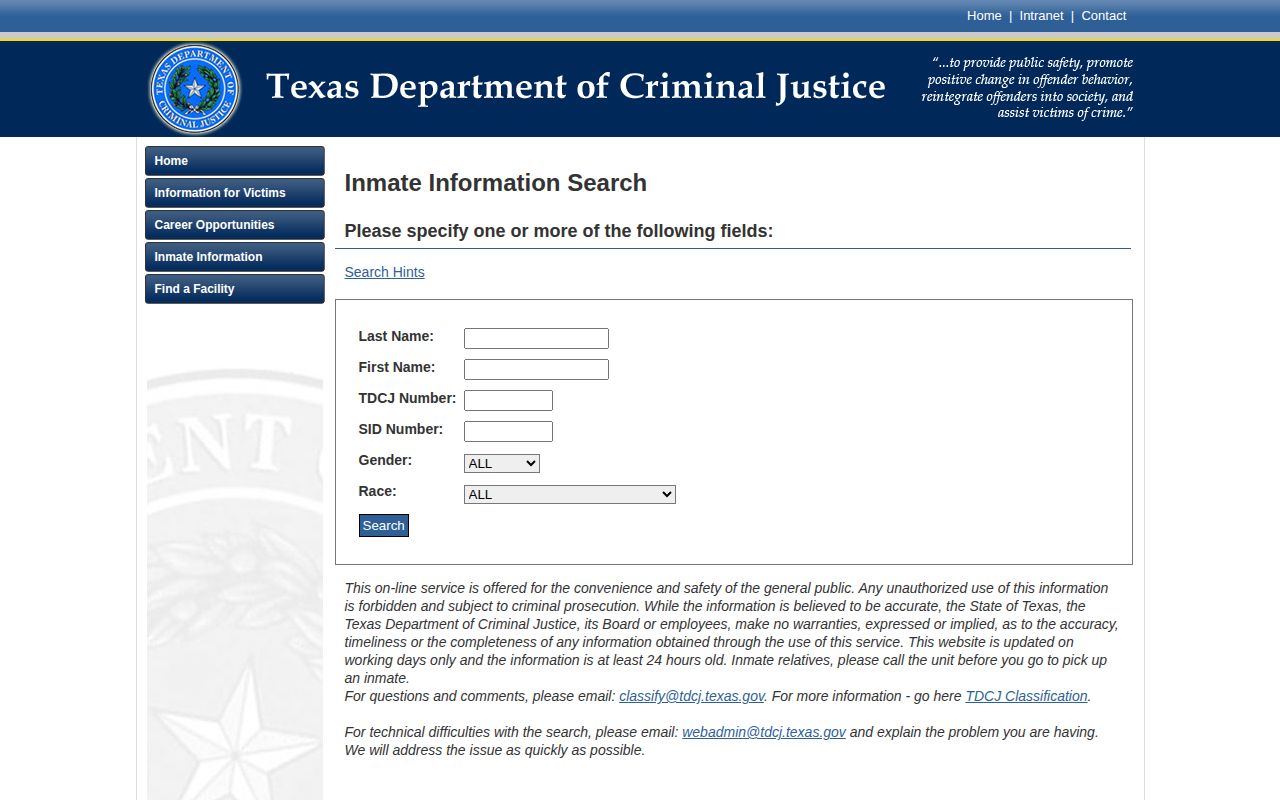
Once a Deaf Smith County person is discharged, state IVSS, the release certificate, parole records, and the judgment provide a stronger historical trail than repeated searches of the current-prisoner screen.
Confirm Deaf Smith Release Timing
For a county-jail case, ask the Sheriff's Office for the admission and release report, booking record, release code, and destination. Supply the full name, bounded booking range, and booking number if known. If a court ordered release, pair the jail timestamp with the docket entry. Do not assume that a person who vanished from a status portal entered the community.
For a state sentence, email pia@tdcj.texas.gov with the full name and TDCJ number. If the number is unknown, provide exact date of birth or approximate age and county of conviction. TDCJ telephone information is available at 936-295-6371 or 800-535-0283 during the stated weekday 8 a.m. to 5 p.m. window. Prerelease Board status uses 844-512-0461; postapproval release status uses 512-406-5202.
Texas IVSS can bridge institutional custody and parole or mandatory supervision, but it is still a status and notification system. The VINELink Release Check explains the state's move from legacy VINE to IVSS-Counties. A formal TDCJ public-information request is the durable channel for the release certificate, actual discharge date, release type, maximum expiration, and public supervision fields.
Note: Record the source, date checked, identifiers used, and exact status wording whenever a Deaf Smith County release date matters.
County Versus State Release Records
A Deaf Smith County release and a TDCJ discharge are separate events even when they concern the same person. The jail may release someone on bond while a criminal case remains pending. It may also transfer a sentenced person to TDCJ, which ends the county custody episode but begins state confinement. For that reason, the county departure timestamp should be read with the release code or destination. A bare “released” label does not prove a return to the community.
Request the Sheriff's admission and release report, jail card or booking record, and any public code definition. Include the full name, booking range, and booking number. When the entry cites court authority, obtain the matching order from the District Clerk for felony or district matters or confirm the misdemeanor route with the County Clerk. A signed order explains why release was authorized. The jail entry is stronger evidence of when physical checkout occurred.
For TDCJ history, a formal request can seek the release certificate, actual discharge date, release type, maximum expiration, and public supervision fields. State IVSS may show parole or mandatory-supervision status after institutional release. Parole means conditional release from a prison term under TDCJ Parole Division supervision. Probation is a court disposition served in the community and is ordinarily handled by the local community-supervision department. The Parole / Probation page routes those records to the correct office.
Retention is another reason to contact the custodian. No Deaf Smith notice establishes how long a booking remains visible online, and there is no county release roster to measure. Ask whether the record is held in the jail system, an archived electronic or paper jacket, or central Sheriff records. For TDCJ, ask Classification and Records or the public-information office for the named record series instead of relying on the current-prisoner locator.
When sources conflict, do not average the dates. Give priority to the newest custodian record, then reconcile it with the judgment, release certificate, and any receiving-agency entry.
Public Record Search
Sponsored Results