
Deaf Smith Parole or Probation
Parole, mandatory supervision, and probation all permit a person to live outside a secure facility, but they arise from different legal paths. Parole is conditional release from a TDCJ prison before the full sentence endpoint. Mandatory supervision is another state-prison release form governed by Texas law and Board review. Both are supervised by the TDCJ Parole Division. Ordinary probation, formally called community supervision, is imposed by a court and is handled through a local Community Supervision and Corrections Department, or CSCD.
The distinction controls where a Deaf Smith County record should be checked. A person who left TDCJ on parole or mandatory supervision maps to the Amarillo District Parole Office. A person placed on probation by a Deaf Smith court should be checked with the Deaf Smith County CSCD and the court that signed the order. Leaving Deaf Smith County Jail on bond is not, by itself, either parole or probation. Bond is a pretrial release condition, and the criminal docket remains the proper source for its terms.
| Question | Parole or mandatory supervision | Probation |
|---|---|---|
| Who orders it? | Texas Board of Pardons and Paroles under state release law | The sentencing court |
| Who supervises it? | TDCJ Parole Division | Deaf Smith County CSCD |
| First local route | Amarillo District Parole Office | Hereford CSCD and the court clerk |
| Best completion proof | TDCJ release or discharge record | Court discharge order and CSCD confirmation |
- Parole
- Conditional community release from a state-prison sentence.
- Probation
- Court-ordered community supervision, often without a prison release.
- Discharge
- The formal end of the supervision obligation.
- Absconder
- A person alleged to have stopped reporting or whose location is unknown to supervision staff.
Check Deaf Smith Release Supervision
Begin with the release source, not a guess based on where the person lives. The standard TDCJ inmate search shows only people currently incarcerated in TDCJ, so a released parolee may no longer appear there. Texas state IVSS can show a person under parole or mandatory supervision and may provide status-change notices. For probation, no statewide parole result replaces the Deaf Smith County CSCD file or the signed court order.
- Identify whether the person left Deaf Smith County Jail, a TDCJ unit, or another custodian. Preserve the full name, date of birth, case number, SID, or TDCJ number when known.
- For a state-prison release, check Texas state IVSS. Compare identifiers and record the exact status and check date.
- Contact the TDCJ county-mapping source and the Amarillo DPO for a Deaf Smith parole or mandatory-supervision question.
- For probation, contact the Deaf Smith County probation office and ask whether it holds the named case, current status, and discharge order.
- Match either office response to the judgment or later order. A docket entry can explain whether supervision began, changed, ended, or was revoked.
If the first search fails, do not treat silence as proof that supervision ended. Names change, identifiers may be mistyped, and some data is restricted or redacted. TDCJ accepts parole information questions through its listed channels, while a formal public-information request is the route for a releasable state record. The Deaf Smith County released-inmate search path explains how to pair that result with the jail departure and court record.
Important: A missing current-custody result does not prove discharge; verify the supervision record with the responsible office.
Deaf Smith Supervision Office Route
Deaf Smith County has a clear two-office rule. State parole and mandatory supervision are routed to Amarillo rather than to a parole office in Hereford. Local probation is routed to the Deaf Smith County CSCD in the courthouse. Sending the same question to both offices can slow the answer and may produce an apparent conflict because each office controls a different kind of record.
The official TDCJ parole county list visually confirms the Deaf Smith-to-Amarillo assignment shown below. That mapping is the key first check after a TDCJ release.
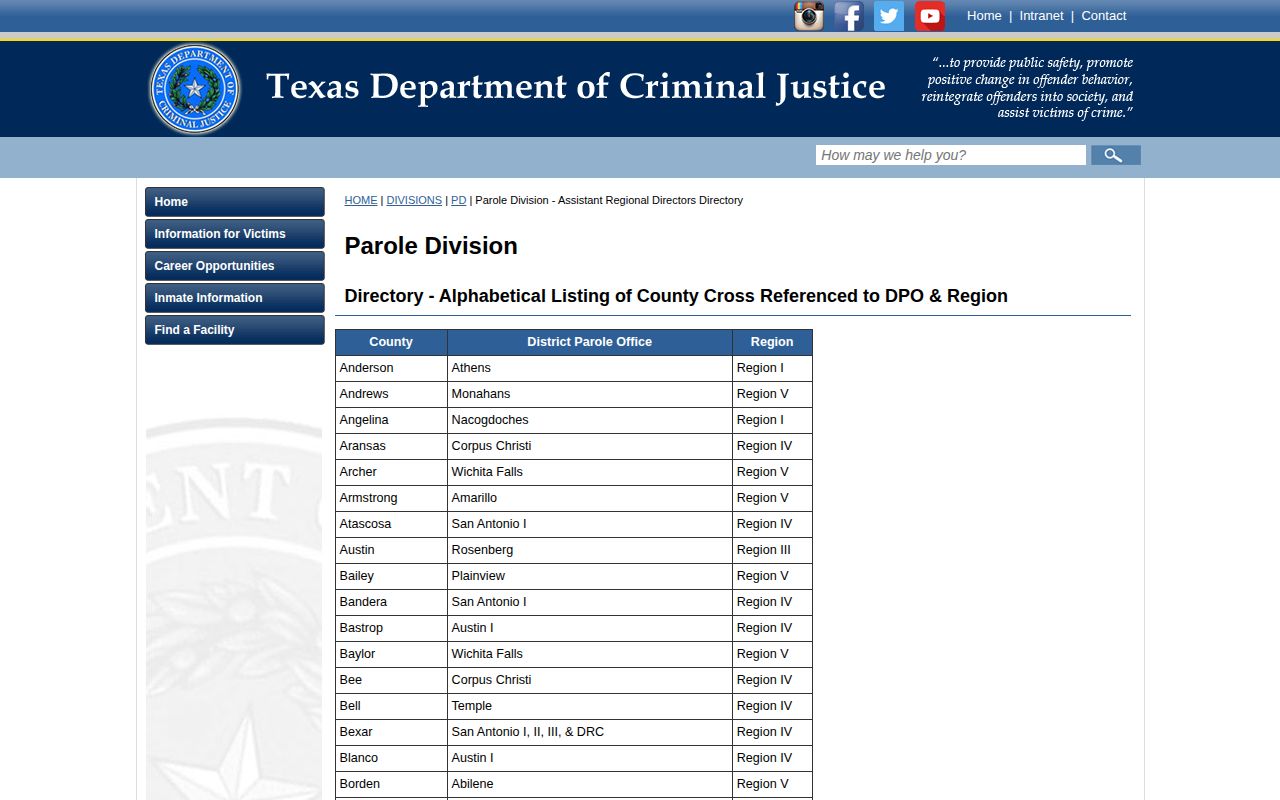
The listing prevents a common routing error: a Hereford address does not mean a parolee is supervised by a Hereford parole office.
Amarillo District Parole Office
Supervisor: Nicole Brooks
5809 South Western Street, Suite 120
Amarillo, TX 79110
Phone: 806-355-9218
Fax: 806-353-9572
Deaf Smith County CSCD
235 E. 3rd Street, Suite 204
Hereford, TX 79045-5542
Use the official local page or TDCJ-CJAD directory to verify the current phone before calling.
For state supervision or location questions, TDCJ also lists io@tdcj.texas.gov. Board information goes to bpp-pio@tdcj.texas.gov, while public-record requests go to pia@tdcj.texas.gov. Those channels serve different purposes. A public-record request should seek an existing record, while an office inquiry can ask where a person reports or which unit handles the case.
Deaf Smith Supervision Changes
Conditions are the rules attached to community release. They may require reporting, approved travel, programs, fees, or compliance with special directions in the actual order. The controlling terms are person-specific. A general list cannot replace the parole certificate, judgment, probation order, or later modification entered in the case.
A warrant or absconder notation is serious, but it does not prove a new conviction or a completed revocation. Texas parole revocation proceedings can lead to continued supervision, added sanctions, an intermediate or treatment placement, or revocation and return to prison. Probation allegations are handled through the court with jurisdiction over that community-supervision case. In either setting, confirm the filed allegation and the final decision separately.
Texas state IVSS may report a parole or mandatory-supervision status change. It is a notification aid, not the official decision record. For a Board outcome, obtain the exact decision or voting code and use the Board’s published explanation. Approval, denial, warrant issuance, arrest, transfer, and physical release are separate events. A concise timeline with dates and source names is more reliable than merging them into one “status.”
Note: Verify an alleged violation through the order or agency record before describing the person’s final supervision status.
Deaf Smith Supervision Discharge
Supervision ends through a formal discharge, sentence endpoint, court action, revocation, or another lawful disposition. Completion should be proved by the agency or court responsible for that case. For parole or mandatory supervision, ask TDCJ for the release and discharge dates and public status fields. Texas public-information law identifies several TDCJ inmate and parole fields that may be released, subject to other statutes, redaction, and valid court orders.
For Deaf Smith County probation, request the discharge or termination order from the correct clerk and confirm it with the CSCD. A successful completion may have legal effects, but it does not erase the case by itself. Expunction and nondisclosure are separate Texas procedures with their own requirements. A record that later becomes unavailable may be controlled by an order or confidentiality rule, so the absence should not be treated as proof of tampering or automatic record destruction.
Keep the final record with the person’s name, cause number, office, effective date, and the date it was obtained. That detail separates the end of physical custody from the end of supervision. It also prevents an old IVSS alert, jail entry, or parole search result from being mistaken for current status.
A formal request should be narrow. For a TDCJ parole record, identify the person by TDCJ number or SID when known and ask for the public release date, parole or mandatory-supervision status, supervising office, warrant status, and discharge date. The Parole Division policy identifies these as potentially releasable fields, but other laws and redactions can still apply. Send an existing-record request to the TDCJ public-information channel rather than asking staff to create a new summary.
For the local route, give the Deaf Smith County CSCD or court clerk the full name and cause number. Ask for the supervision order, later modifications, revocation filings, and final discharge order that are public in that case. The office response and court record should agree on which case ended. If they do not, preserve both dates and ask the record custodian to explain only the fields it maintains. One person may have more than one case, and one completed term does not prove that every supervision obligation ended.
Where Deaf Smith Parole Reports
A Deaf Smith County address creates an unusual but simple office split. A person released from state prison on parole or mandatory supervision reports through the Amarillo DPO assignment, while an ordinary probationer reports through the Hereford CSCD and the local court. The difference comes from the legal source of supervision, not the person’s preferred office or the site of an earlier jail stay.
The TDCJ Region V office page provides the current Amarillo contact displayed in the official capture below.
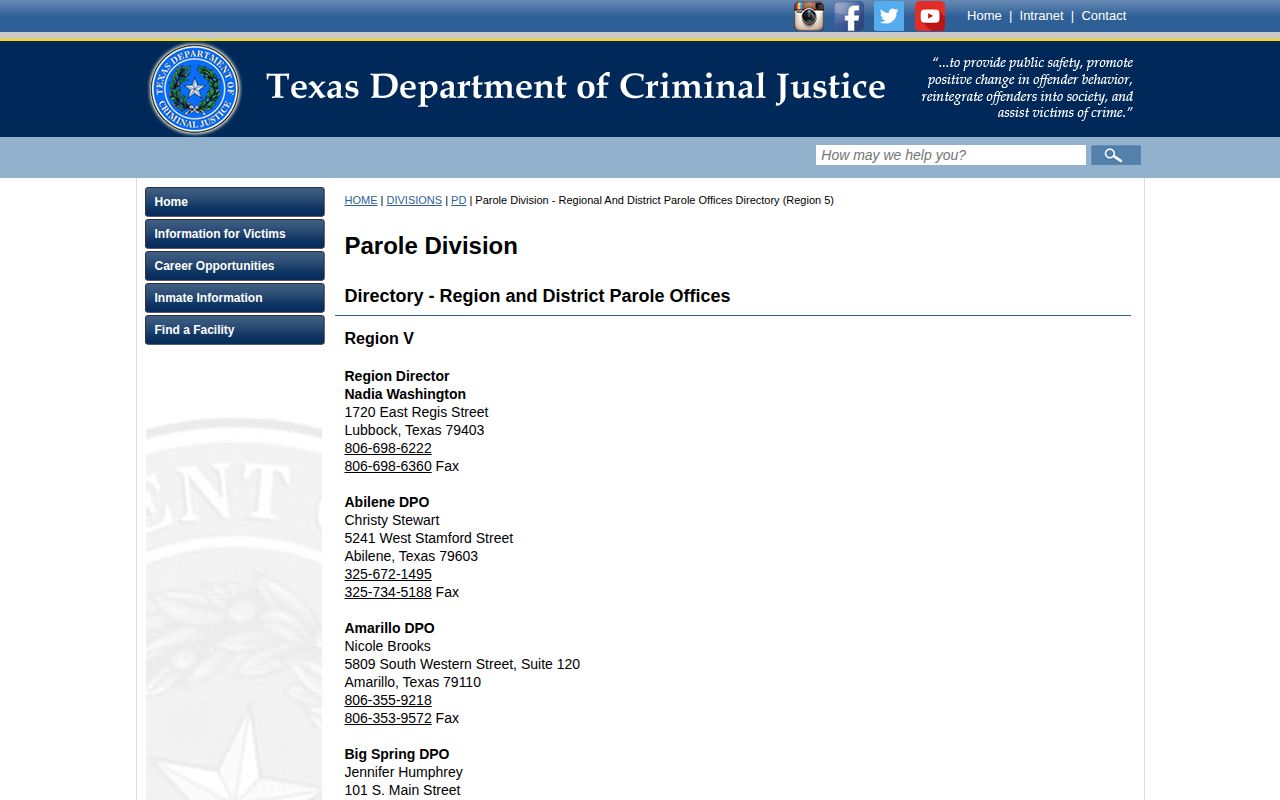
Confirm the assignment before travel because reporting instructions in the individual release documents control. If the person is on probation instead, the Deaf Smith County CSCD and the sentencing court remain the right route. This local routing rule is the fastest way to avoid mixing a TDCJ parole file with a county probation file.
Public Record Search
Sponsored Results